

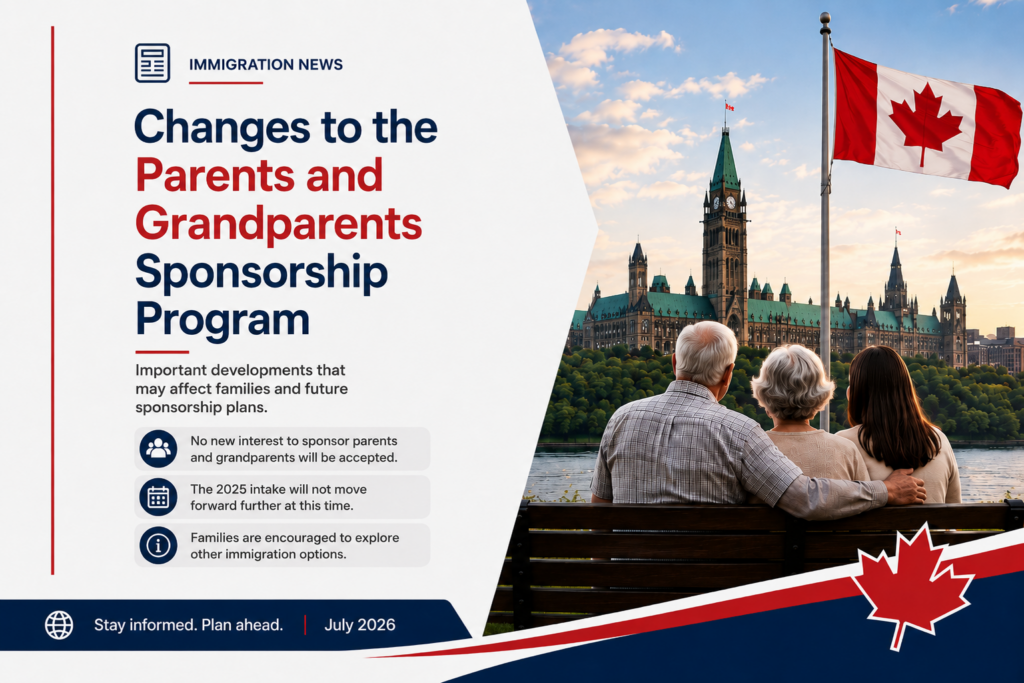
Canada has paused new intake under the Parents and Grandparents Program, commonly known as the PGP.
Effective July 15, 2026, Immigration, Refugees and Citizenship Canada will no longer accept new Interest to Sponsor forms or issue new invitations to potential sponsors until further notice.
The announcement does not cancel the program or applications already submitted. IRCC will continue processing existing files, but Canadian citizens and permanent residents who were not previously invited currently have no way to submit a new PGP sponsorship application.
What exactly has changed?
IRCC has placed the Parents and Grandparents Program in paused status.
For now:
- no new Interest to Sponsor forms will be accepted;
- no new invitations to apply will be issued;
- people who were not previously invited cannot submit a new PGP application;
- applications already received will continue to be processed;
- there is no confirmed date for a future intake.
The phrase “until further notice” is important. It means the program has not necessarily been permanently abolished, but families should not assume that a new intake will open soon.
Who is affected by the pause?
The announcement mainly affects Canadian citizens and permanent residents who want to sponsor their parents or grandparents but do not already have an application in progress.
People who were waiting for a new opportunity to submit an Interest to Sponsor form will now have to wait for a future government announcement.
The pause does not create a special exception for families based on age, medical needs, length of separation, or the sponsor’s financial ability.
What happens to applications already submitted?
IRCC will continue processing applications that it has already received.
Applicants with pending files should continue to:
- monitor their IRCC account;
- respond to document requests by the deadline;
- complete medical or biometric requirements when requested;
- report changes in address, marital status, family composition, or contact information;
- maintain copies of all correspondence and supporting documents.
A pending application is not cancelled simply because the program has been paused for new intake.
However, continued processing does not guarantee approval. Sponsors and applicants must still meet all financial, relationship, admissibility, and program requirements.
Why is this significant?
The PGP is one of Canada’s most limited and competitive family immigration programs.
Demand has consistently been much higher than the number of permanent residence spaces available. The last new Interest to Sponsor forms were collected in 2020, and invitations issued in later years were drawn from that existing pool.
This meant many Canadian citizens and permanent residents had already been unable to express new interest for several years.
The July 2026 pause extends that uncertainty. Unless the government changes direction, people who were not part of the earlier pool will continue to have no direct access to the PGP application process.
Is parent and grandparent sponsorship permanently closed?
IRCC has not described the measure as a permanent closure.
The official program status is paused, and the government has said it will not accept new forms or issue invitations until further notice.
This distinction matters. Headlines suggesting that sponsorship has been completely eliminated are stronger than the government’s official announcement.
Still, families should be realistic: there is no announced reopening date, and no one can guarantee when or whether a new intake system will be introduced.
What option remains for parents and grandparents?
The main alternative is the super visa.
A super visa may allow eligible parents and grandparents to visit their children or grandchildren in Canada for up to five years at a time. It can provide multiple entries during a validity period of up to ten years.
Parents and grandparents already in Canada on a super visa may also be able to apply for extensions of up to two years.
However, a super visa is not permanent residence. It is a temporary immigration option and does not provide the same rights or long-term certainty as approval under the PGP.
Super visa requirements
Eligibility for a super visa may depend on several factors, including:
- the relationship between the applicant and the Canadian host;
- the host’s immigration status in Canada;
- the host meeting the required minimum income;
- a signed invitation and financial-support commitment;
- qualifying private medical insurance;
- completion of an immigration medical examination where required;
- the applicant’s medical, criminal, and security admissibility;
- convincing the officer that the applicant is a genuine temporary resident.
A regular visitor visa may be more suitable where the planned visit is shorter.
What should families do now?
Families affected by the pause should avoid making decisions based only on dramatic headlines.
A practical approach is to:
- confirm whether a PGP application is already in process;
- review whether the parent or grandparent qualifies for a super visa;
- consider a regular visitor visa for shorter visits;
- assess the host’s income and insurance requirements;
- monitor official IRCC announcements for any future intake;
- address medical, criminal, or previous refusal issues before applying;
- keep financial and civil-status documents organized in case the PGP reopens.
Be careful of false promises
No consultant, lawyer, agent, or website can privately add someone to the PGP pool while the program is paused.
Families should be cautious of anyone claiming to have:
- guaranteed sponsorship spaces;
- access to a private invitation list;
- an advance registration system;
- a way to submit an application without an IRCC invitation;
- guaranteed approval through a super visa.
The pause applies nationally, and applications must follow the process established by IRCC.
Final note
Canada has paused new intake under the Parents and Grandparents Program, but existing applications will continue to be processed.
For families who were not previously invited, the super visa is currently the main option for extended visits. It does not provide permanent residence, but it may allow eligible parents and grandparents to spend longer periods with their family in Canada.
Need help reviewing options for your parents or grandparents?
Contact Nextland Immigration to discuss the Parents and Grandparents Program, super visa, or visitor visa.
