
'/%3E%3C/svg%3E)
Ontario Immigrant Nominee Program (OINP)
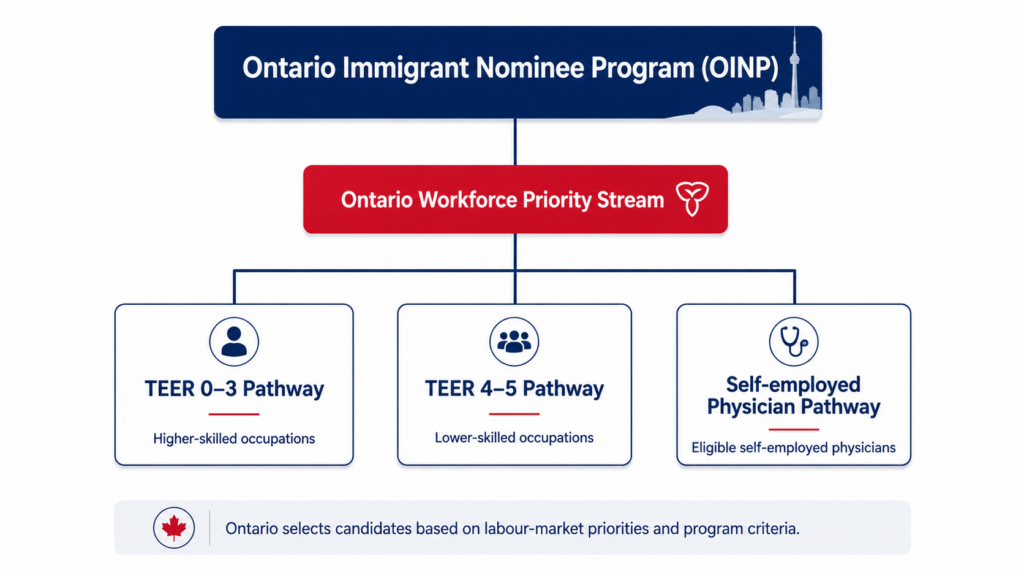
The Ontario Immigrant Nominee Program, also known as the OINP, allows Ontario to nominate eligible foreign nationals for Canadian permanent residence.
Ontario is Canada’s most populous province and has one of the largest and most diverse labour markets in the country. The province uses the OINP to select candidates who can help meet Ontario’s workforce, economic, and community needs.
A provincial nomination can support a candidate’s permanent residence pathway. For Express Entry candidates, a nomination can add 600 Comprehensive Ranking System, CRS, points. For non-Express Entry applicants, nomination may provide a direct provincial pathway to apply for permanent residence through the federal government.
Main OINP pathway: Ontario Workforce Priority Stream
Ontario has redesigned the OINP structure by introducing the Ontario Workforce Priority Stream.
This stream is designed to help Ontario select workers who are aligned with the province’s labour-market priorities. The stream includes three main pathways:
1. TEER 0–3 Pathway
The TEER 0–3 Pathway is for workers in higher-skilled occupations.
TEER 0, 1, 2, and 3 occupations may include management, professional, technical, skilled trades, and other occupations that usually require higher levels of training, education, experience, or responsibility.
This pathway may be suitable for candidates who have a qualifying Ontario job offer and meet the program requirements related to occupation, work experience, language, education, licensing, employer eligibility, and settlement intention.
2. TEER 4–5 Pathway
The TEER 4–5 Pathway is for workers in lower-skilled or intermediate occupations.
TEER 4 and 5 occupations may include jobs that require secondary school, job-specific training, or on-the-job training. This pathway may help Ontario employers retain workers in essential or hard-to-fill roles.
Candidates should not assume that all TEER 4 or 5 jobs will automatically qualify. The job offer, employer, occupation, wage, work history, and program requirements must be reviewed carefully.
3. Self-employed Physician Pathway
The Self-employed Physician Pathway is designed for eligible physicians in Ontario.
This pathway may help certain self-employed physicians qualify for nomination where their work arrangement does not fit the traditional employer-employee job offer model.
This is an important change because many physicians may work through professional billing or practice arrangements. Eligibility may depend on professional registration, Ontario practice requirements, OHIP billing conditions, and other program criteria.
Expression of Interest and selection
Many OINP applicants must first register an Expression of Interest, also known as an EOI.
An EOI is not the same as an application for nomination. It is a way to tell Ontario that you are interested in being considered under a stream. Ontario may then invite candidates based on labour-market needs, program priorities, score, occupation, employer factors, and available nomination allocation.
Submitting an EOI does not guarantee an invitation.
Who may be a stronger candidate for the OINP?
A candidate may have a stronger profile if they have:
- a valid Ontario job offer, where required;
- work experience in an occupation needed by Ontario;
- a correct NOC and TEER classification;
- an employer that meets OINP requirements;
- strong English or French language ability;
- required education or licensing;
- current work or study connection to Ontario;
- a credible intention to live and work in Ontario;
- complete and consistent documents.
For physician applicants, professional registration, practice structure, and OHIP billing eligibility may be especially important.
Important points before applying
Before submitting an EOI or OINP application, candidates should carefully review:
- whether their pathway is currently open;
- whether their NOC and TEER level are correct;
- whether the job offer meets Ontario requirements;
- whether the employer is eligible and ready to support the application;
- whether wage and employment terms meet program rules;
- whether licensing or professional registration is required;
- whether language and education requirements apply;
- whether all documents are complete, accurate, and consistent.
Small errors in job title, NOC code, TEER classification, employer information, work history, wage details, or settlement intention can weaken the application.
Ontario is competitive
Ontario is a major destination for immigrants, students, workers, and professionals. This also means that OINP pathways can be competitive.
A candidate should not apply only because they work in Ontario. The stronger question is whether the candidate’s profile matches Ontario’s current selection priorities and whether the application can be supported with strong evidence.
How Nextland Immigration can help
Nextland Immigration can help you review your Ontario immigration options and determine whether the OINP is a realistic pathway for your situation.
We can assist with:
- OINP eligibility review;
- NOC and TEER assessment;
- job offer and employer-document review;
- Expression of Interest preparation;
- pathway selection;
- document checklist preparation;
- application review before submission;
- strategy after receiving an invitation;
- permanent residence planning after nomination.
Final note
Ontario can be a strong immigration option for workers, employers, and eligible physicians. However, the OINP is not automatic. The province selects candidates based on program requirements, labour-market priorities, and available nominations.
The right strategy is not to apply blindly. The right strategy is to confirm whether your profile actually fits Ontario’s current pathways and whether your documents can support the application.
Interested in Ontario immigration?
Contact Nextland Immigration to review your OINP options.