

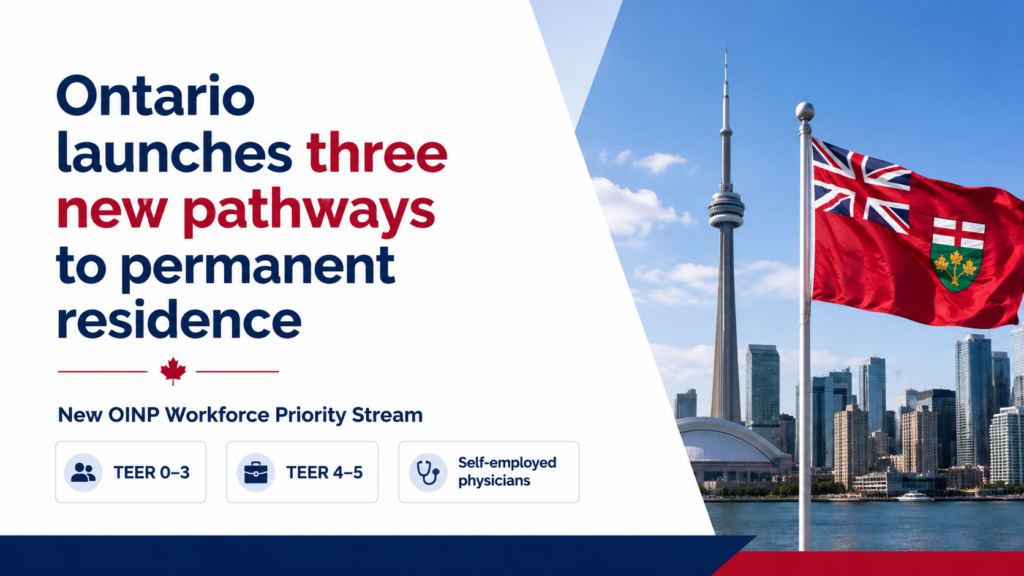
Ontario has launched a major update to the Ontario Immigrant Nominee Program, known as the OINP, by introducing the new Ontario Workforce Priority Stream.
The new stream includes three pathways:
- TEER 0–3 pathway
- TEER 4–5 pathway
- Self-employed physician pathway
These changes came into effect on June 26, 2026, as part of Ontario’s broader effort to redesign its provincial immigration system and better respond to labour-market needs.
What changed?
Ontario has introduced the Ontario Workforce Priority Stream as a new structure for employer-supported permanent residence pathways.
The purpose of the redesign is to help Ontario select workers who can support the province’s workforce needs, including candidates in both higher-skilled and lower-skilled occupations, as well as certain eligible self-employed physicians.
This is important because Ontario’s labour market includes different types of shortages. Some are in professional and technical roles, while others are in essential or hard-to-fill positions.
The three new pathways
1. TEER 0–3 pathway
This pathway is for workers in higher-skilled occupations classified under TEER 0, 1, 2, or 3 of Canada’s National Occupational Classification system.
These occupations may include management, professional, technical, skilled trades, and other roles that require higher levels of training, education, experience, or responsibility.
2. TEER 4–5 pathway
This pathway is for workers in TEER 4 or 5 occupations.
These occupations may include roles that require secondary school, job-specific training, or on-the-job training. This pathway may be useful for employers trying to retain workers in essential or difficult-to-fill positions.
3. Self-employed physician pathway
Ontario has also created a pathway for eligible self-employed physicians.
This is a meaningful change because some physicians may work under billing or practice arrangements that do not fit the traditional employer-employee job offer model. The pathway may help eligible physicians continue working in Ontario while pursuing permanent residence.
What this means for applicants
The new stream may create opportunities for workers and physicians in Ontario, but it does not mean that every worker automatically qualifies.
Applicants still need to carefully review:
- their correct NOC code;
- their TEER category;
- whether their Ontario job offer qualifies, if required;
- employer eligibility;
- language requirements;
- education and work experience requirements;
- licensing or professional registration requirements;
- whether their profile matches Ontario’s current priorities.
A candidate should not rely only on the fact that their occupation falls under TEER 0–3 or TEER 4–5. Ontario may still select candidates based on workforce priorities, available nominations, and program-specific criteria.
What this means for Ontario employers
The new pathways may help Ontario employers support foreign workers for permanent residence, especially where there are labour shortages or retention challenges.
However, employer requirements remain important. A strong worker profile can still fail if the employer does not meet the program requirements or if the job offer is not properly documented.
Employers should review eligibility before supporting a candidate under the OINP.
Final note
Ontario’s new Workforce Priority Stream is an important change for workers, employers, and self-employed physicians.
The strong approach is to review the full profile before applying: NOC, TEER level, job offer, employer documents, work history, language results, and settlement intention.
Need help reviewing your Ontario immigration options?
Contact Nextland Immigration to assess your pathway.
